
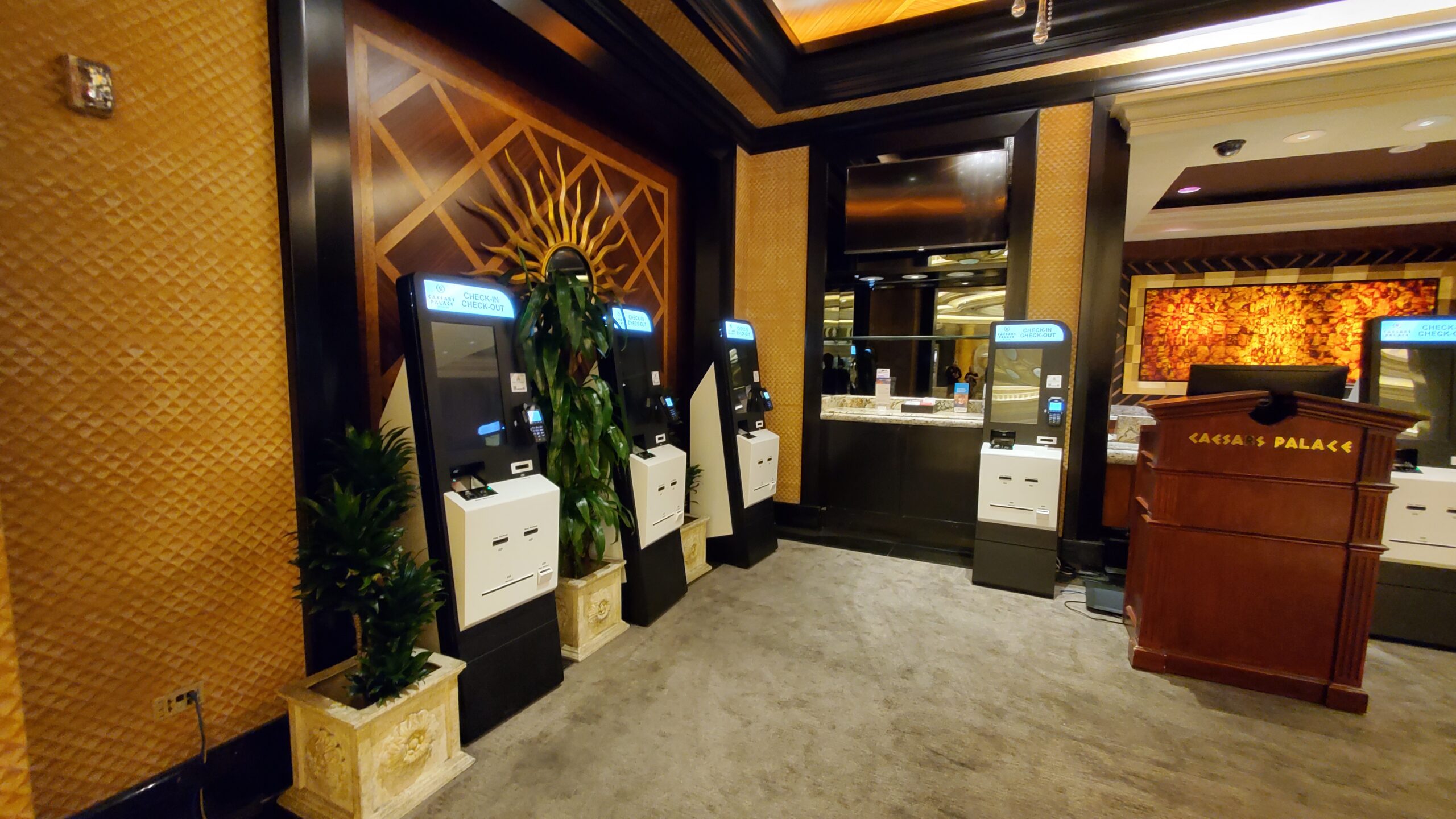
For hotels, resorts, casinos, and hospitality groups, the check-in experience is both an operational challenge and an important part of the guest journey. Peak arrival periods can create long front-desk lines, while routine transactions consume staff time that could be spent assisting guests with more complex needs. A hotel kiosk gives properties another way to manage those transactions. When properly integrated with hotel systems, self-service kiosks can support check-in, payment, identity verification, room-key issuance, checkout, and other common guest interactions from a single station. The value is not simply automation. The objective is to create a more efficient arrival process while maintaining the level of service guests expect from a hospitality brand.
Hotel self-service works best as an extension of the front desk rather than a replacement for it. Guests with straightforward reservations can complete routine steps through a kiosk, while employees remain available for room changes, special requests, billing questions, upgrades, and other situations where personal assistance adds value. This model is particularly useful for high-volume properties where guest arrivals tend to occur in concentrated periods. Instead of routing every guest through the same front-desk queue, hotels can distribute transactions across multiple service points. For enterprise hospitality operators, that can improve lobby throughput without sacrificing access to staff.
One of the clearest advantages of a hotel check-in kiosk is additional transaction capacity. During peak arrival periods, guests can retrieve reservations, verify information, process payment, and complete other routine steps without waiting for an available front-desk agent. For larger hotels, resorts, casinos, and convention properties, multiple kiosks can also provide a scalable way to manage changing guest volumes.
Many parts of hotel check-in are transactional. Reservation lookup, payment authorization, registration, and room-key issuance do not always require a lengthy employee interaction. Moving appropriate transactions to self-service allows staff to concentrate on guests who need assistance. The goal should not be to remove hospitality from the arrival experience. It should be to use employees where their knowledge and personal service create the most value.
Guest preferences vary. Some travelers prefer speaking directly with hotel staff. Others want to complete check-in quickly and continue to their room. Providing both options gives the guest greater control over the arrival experience while allowing the property to serve different types of travelers through the same lobby.
Self-service can also support properties that experience late-night arrivals, large group traffic, event-driven demand, or other periods where transaction volume does not align neatly with front-desk staffing. A properly designed kiosk provides another channel through which routine guest transactions can be completed consistently.
The kiosk enclosure itself is only one part of the solution. A successful hotel self-service deployment depends on the kiosk hardware, software, property management system, payment technology, room-key system, and other hotel infrastructure working together. Depending on the application, a hotel kiosk may need to accommodate:
The exact configuration should be determined by the hotel’s intended workflow. For example, allowing a guest to complete most of the check-in process at a kiosk but then requiring them to stand in line for a room key limits the operational benefit. The complete guest journey should be considered before the hardware is designed.
For larger deployments, kiosk selection should extend beyond screen size and appearance.
The kiosk must accommodate the hardware required by the hotel’s software, PMS, payment provider, identity verification process, and access-control system.
A hotel kiosk may process a significant number of transactions throughout the day. Components, enclosure construction, thermal management, and internal layout should be designed for commercial use rather than treated as an afterthought.
Printers need paper. Key-card dispensers need replenishment. Payment devices, scanners, and other components may eventually require maintenance or replacement. The internal kiosk layout should allow authorized employees and technicians to reach these components efficiently without unnecessarily disrupting the entire unit.
Accessibility should be considered during the initial design process, including touchscreen positioning, peripheral placement, reach ranges, clear floor space, and the surrounding installation environment. Our guide to ADA-compliant kiosks provides additional considerations for accessible self-service design.
A successful pilot may eventually become a deployment across multiple properties. Hotel groups should consider whether the kiosk design can be manufactured consistently, supported over time, and adapted as technology requirements change.
For enterprise hospitality projects, choosing a hotel check-in kiosk manufacturer should involve more than selecting an enclosure from a catalog. The manufacturer should understand how industrial design, engineering, component integration, fabrication, service access, branding, and long-term production affect the final deployment. At Kiosk Innovations, we design and manufacture hotel check-in kiosks around the requirements of each hospitality application. Our team works with hotel operators, software providers, payment partners, and technology integrators to develop kiosk hardware that supports the intended guest workflow. When an off-the-shelf enclosure cannot efficiently accommodate the required technology or brand experience, a custom kiosk can be engineered around the specific application rather than forcing the application around an existing kiosk.
Hotel self-service kiosks can reduce front-desk congestion, expand transaction capacity, and give guests more control over how they arrive and check in. However, those benefits depend on more than installing a touchscreen in the lobby. The most successful hotel kiosk deployments are designed around the complete transaction: software, PMS integration, payment, identity verification, room-key issuance, accessibility, serviceability, and the physical environment all need to work together. If your organization is evaluating a self-service deployment, explore our hotel check-in kiosk solutions to learn how Kiosk Innovations approaches design, engineering, integration, and manufacturing for hospitality applications.