
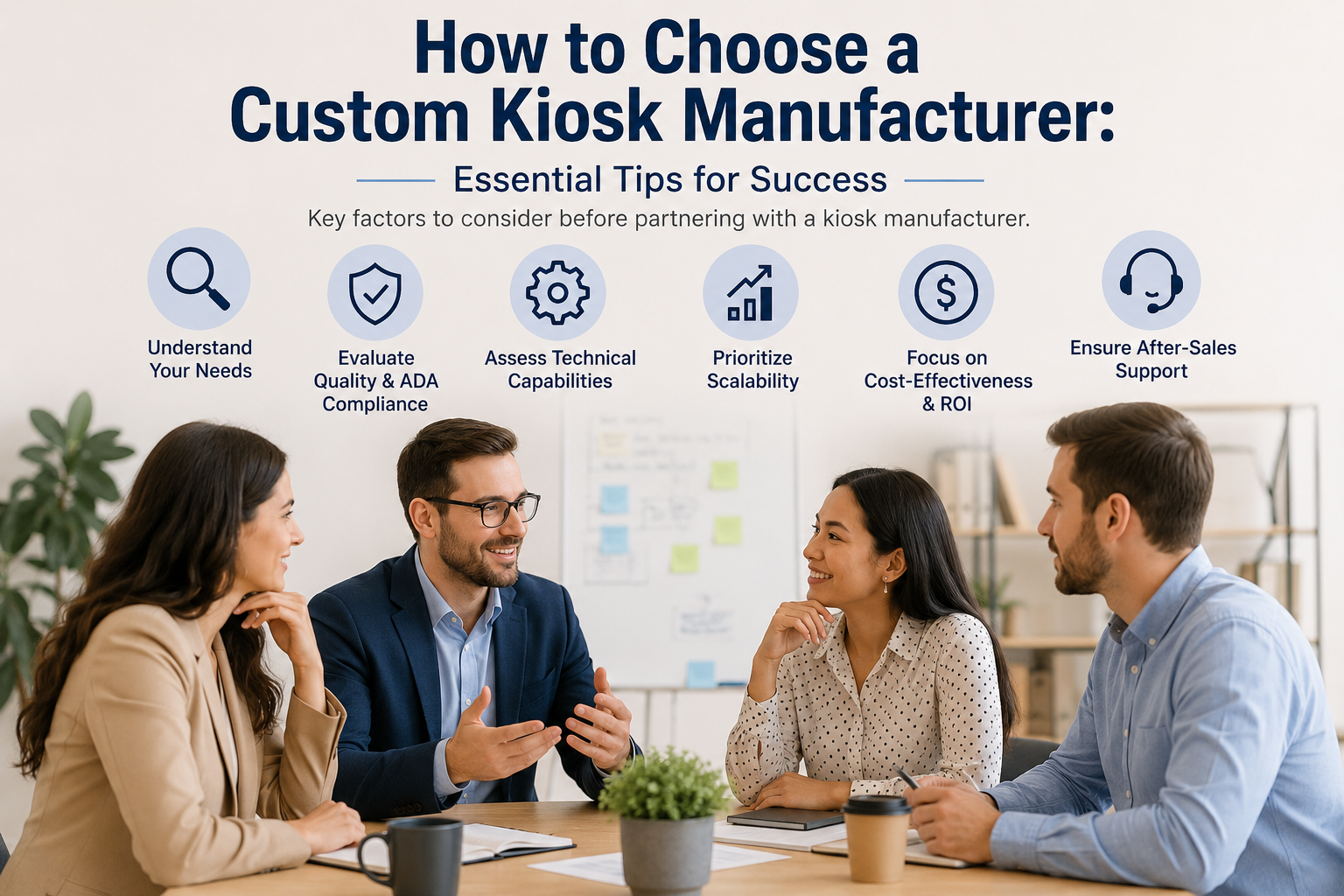
Choosing the right custom kiosk manufacturer involves much more than comparing enclosure designs and unit pricing. The manufacturer you select can directly influence kiosk reliability, serviceability, hardware integration, accessibility, production consistency and the long-term cost of supporting your deployment. A qualified custom kiosk manufacturer should be able to take a project from initial requirements and industrial design through engineering, component integration, prototyping and production while designing around the environment and workflow in which the kiosk will operate.
It is also important to understand that custom does not necessarily mean unnecessarily expensive or complex. A well-designed custom kiosk is purpose-built around a particular use case. For recurring deployments, designing the enclosure efficiently around the required hardware, environment, user experience and service needs can provide significant advantages over forcing an application into a generic kiosk design. Before selecting a manufacturing partner, organizations should understand what capabilities separate experienced kiosk manufacturers from companies that simply fabricate enclosures.
A custom kiosk manufacturer should provide more than metal fabrication. Look for experience in industrial design, mechanical and electrical engineering, hardware integration, prototyping, production, quality control, accessibility, serviceability and long-term component support. The right manufacturer should also understand the environment where the kiosk will be installed and how customers will actually interact with it. A kiosk used for hotel check-in has different requirements than an outdoor payment kiosk, healthcare registration kiosk or entertainment kiosk. The following ten factors can help you evaluate potential kiosk manufacturers and determine which company is best equipped to support your deployment.
Engineering is one of the most important differences between kiosk manufacturers. A kiosk may appear straightforward from the outside, but the enclosure has to support the screen, computer, payment devices, printers, scanners, wiring, ventilation, power supplies and other components required by the application. When evaluating a manufacturer, ask whether its team has experience with:
Good kiosk engineering considers how all of these elements work together before production begins. At Kiosk Innovations, our custom kiosk design and manufacturing process starts by understanding the application’s requirements and developing the kiosk around the specific hardware, environment, branding and operational needs of the deployment.
A custom kiosk is usually an integration of several different technologies rather than a single piece of hardware. Depending on the application, a kiosk may include:
The important question is not simply whether these components can physically fit inside the enclosure. An experienced custom kiosk manufacturer should consider cable routing, heat generation, ventilation, customer reach, security, service access and how individual components can be replaced in the future. Payment applications require additional planning because the kiosk hardware, software, processor and payment terminal all need to work together. Businesses planning transactional kiosks can learn more in our guide to integrating payment systems with self-service kiosks.
Before committing to production, buyers should understand how the manufacturer moves a kiosk from an idea to a finished product. A strong custom kiosk development process includes:
Requirements → Concept → Engineering → CAD Development → Renderings → Prototype → Testing and Refinement → Production
Early design and engineering help identify potential problems before they become expensive production issues. It’s important to ask potential kiosk manufacturers:
Prototyping is especially valuable for new applications because it allows the hardware layout, customer interaction, servicing process and overall kiosk design to be evaluated before committing to volume production.
A successful prototype is only the beginning if the project eventually requires dozens, hundreds or thousands of kiosks. The manufacturer should be capable of repeatedly producing the same design while maintaining consistent quality across every unit. When comparing kiosk manufacturing services, consider how the manufacturer handles:
Repeatability becomes especially important as deployment volume increases. Small inconsistencies in component placement, assembly procedures or wiring can become much larger operational problems across a large kiosk fleet. Organizations planning larger programs should also consider how the kiosk will be packaged, shipped, installed and supported across multiple locations. Our guide to large self-service kiosk deployments explains why these considerations become increasingly important as deployments scale.
Serviceability is one of the most overlooked factors when choosing a custom kiosk manufacturer. Every kiosk will eventually require maintenance. Printers need supplies, computers may need replacement, payment terminals can change, displays may fail and other components may need to be accessed over the life of the deployment. A kiosk that is difficult to service can create unnecessary downtime and increase field-service costs. Good kiosk designs consider:
These considerations may not be immediately visible when comparing kiosk renderings, but they can have a major impact once the units are operating in the field.
This is also why the lowest initial kiosk price does not always result in the lowest long-term cost. Our article on the hidden costs of cheap kiosk manufacturing explains how engineering, serviceability, component selection and reliability can affect the true cost of a deployment.
A kiosk deployment may be expected to operate for years, making component availability an important part of the design process. Before production, manufacturers should consider the expected lifecycle of components such as:
Ask what happens if a component reaches end-of-life or becomes unavailable after deployment. Can a replacement be integrated without significantly redesigning the kiosk? Are spare components available? Is the hardware intended for continuous commercial use? Selecting a cheaper component that disappears from the market shortly after deployment can create expensive support and redesign problems later. An experienced kiosk manufacturer should be thinking beyond the initial production run and considering how the system can be maintained throughout its expected lifecycle.
Accessibility should be considered during kiosk design rather than addressed after the kiosk has already been engineered. The specific requirements that apply can vary depending on the application, location and type of kiosk, but accessibility considerations can include:
The U.S. Access Board’s resources on self-service transaction machines and kiosks provide useful information regarding accessibility considerations for self-service technology.
Because physical enclosure design and software accessibility can affect one another, these requirements should be discussed early in the development process.
Businesses evaluating an accessible kiosk deployment can also review our guide to ADA-compliant kiosks for additional design considerations.
For transactional kiosks, hardware is only one part of the system. The enclosure may need to support communication between the kiosk computer, application software, payment terminal, processor and other peripherals. Before selecting a manufacturer, determine what systems must be integrated and which parties are responsible for each part of the deployment. If payment cards are accepted, payment security should also be addressed from the beginning. The PCI Security Standards Council maintains PCI DSS requirements intended to protect payment account data. A kiosk manufacturer does not necessarily control every part of the payment environment, so buyers should understand the responsibilities of the manufacturer, software provider, payment processor, merchant and terminal provider before deployment. The physical kiosk should also protect payment hardware from unauthorized access while still allowing authorized technicians to service or replace equipment when necessary.
Price matters, especially when deploying kiosks at scale, but purchase price should not be the only factor used to compare manufacturers. A better comparison considers the total cost of ownership over the expected life of the kiosk.
This can include:
A lower-priced kiosk that requires frequent repairs or becomes difficult to support can ultimately cost more than a purpose-built design that was engineered for long-term operation. Custom manufacturing should therefore be viewed in terms of efficiency rather than unnecessary complexity. When an application will be deployed repeatedly, designing the kiosk specifically around the required components and workflow can make the system easier to produce, support and maintain.
The relationship with a kiosk manufacturer should not necessarily end when the first production run ships. Before choosing a partner, ask what support is available throughout the life of the deployment.
Depending on the project, considerations may include:
This becomes particularly important when a pilot program develops into a national or multi-location deployment. The original kiosk needs to be designed in a way that allows the program to scale without creating unnecessary manufacturing, installation or servicing problems later.
Choosing a custom kiosk manufacturer is ultimately about finding a company capable of supporting the full lifecycle of your self-service program. Look beyond appearance and initial unit pricing. Evaluate how each manufacturer approaches engineering, hardware integration, component selection, accessibility, serviceability, quality control, production and long-term support. The strongest kiosk deployments are usually the result of these factors being considered before production begins.
Kiosk Innovations designs and manufactures purpose-built custom kiosks around the specific requirements of each application. Our process takes projects from concept and engineering through renderings, component integration and production, with designs developed around the hardware, environment, branding, accessibility and service needs of the deployment. Whether you are developing a new self-service application, improving an existing kiosk design or preparing to scale a larger rollout, selecting the right manufacturing partner early can help create a kiosk platform that is easier to produce, deploy, maintain and support over the long term.
Planning a custom kiosk project? Contact Kiosk Innovations to discuss your application, hardware requirements and deployment goals.