
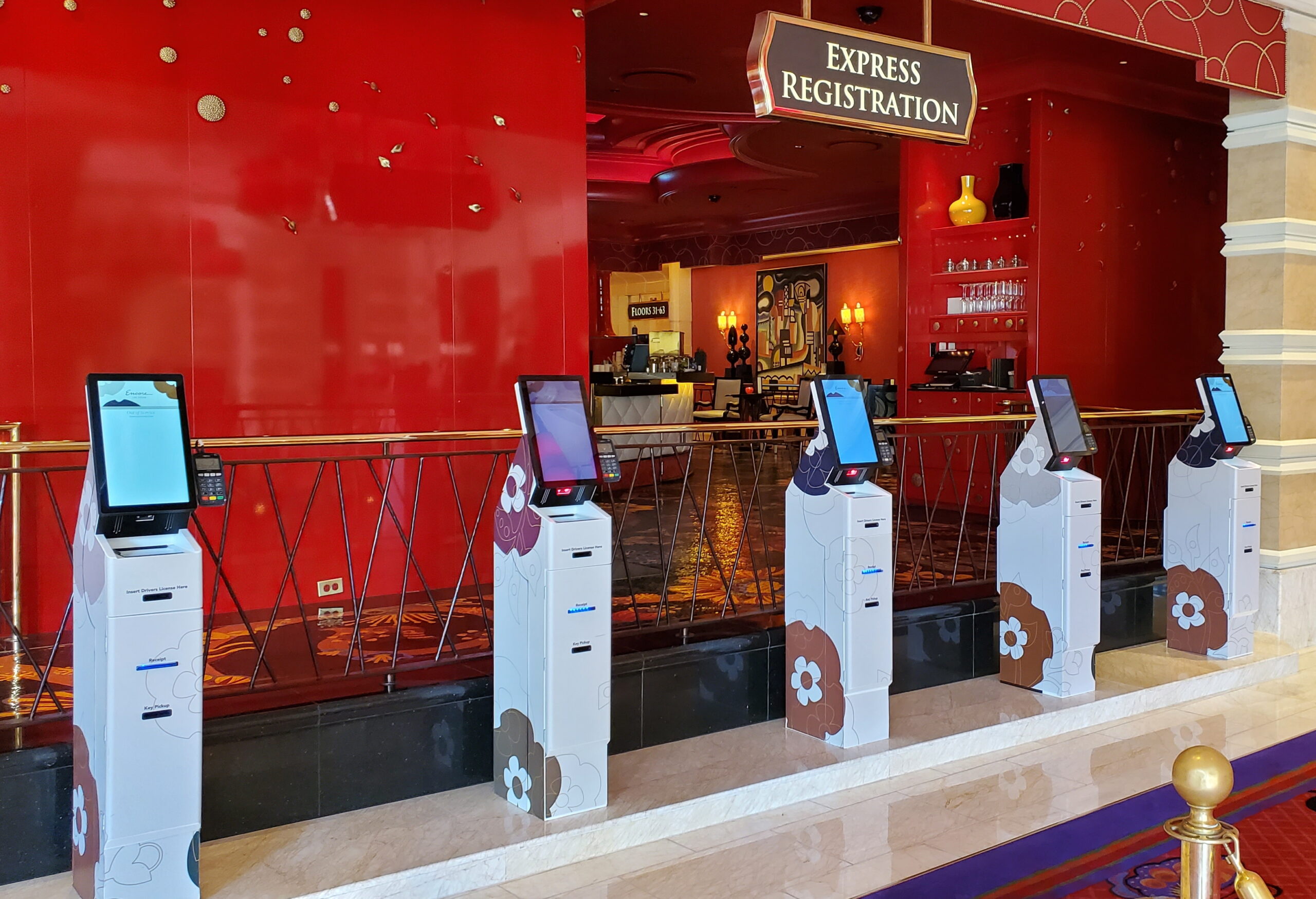
In the self-service industry, check-in kiosks have become an important element of hotel operations. As hotels look for ways to improve efficiency, labor cost savings, reduce wait times, and support changing guest expectations, self-service kiosks are being integrated directly into check-in processes. In the hotel industry, guest experiences are largely impacted by the design of the kiosk, how intuitive the process is, and how reliable the kiosk performs. Even if a guest only spends a few minutes at a kiosk, that interaction often creates the guest’s first impression of the property. For hotels, check-in kiosks must be designed with speed, simplicity, privacy, and reliability in mind, without adding friction at the point of arrival.
Hotel check-in kiosk first impressions matter, oftentimes the kiosk shapes a guest experience that can have an effect on other purchasing decisions like spa treatment, restaurant reservations, or even playing slots. After traveling, carrying heavy luggage, dealing with family, or being on a tight schedule, guests are often exhausted. Any confusion, delays, or technical issues can instantly create friction for your guest, check-in kiosks are designed to simplify the arrival process and not complicate it. The moment a guest approaches the kiosk, the user interface, screen layout, hardware integrations, and transaction speed should all feel natural and easy to understand, kiosks should not require training or assistance for basic actions like:
One of the largest operational advantages of hotel check-in kiosks is reducing wait times at the front desk during demanding arrival periods. This quickly impacts the overall guest experience depending on how busy or crowded the lobby is. In addition, peak check-in times can create long lines in hotels, resorts, casinos, conference hotels, or properties hosting events. Self-service kiosks help distribute guest traffic and allow staff to focus on higher-value guest interactions instead of repetitive transactional tasks. However, reducing congestion only works if the kiosk remains efficient and dependable.
Late-night arrivals are a very important use case for hotel self-check-in kiosks. Guests that arrive late often want the fastest possible experience with minimal interaction or delays, at the same time, hotel staffing may be reduced overnight which creates more importance for a reliable kiosk.
ID and passport scanning have become common requirements in many self-check-in deployments. Automating ID verification helps speed up registration which reduces manual errors at the front desk. If a scanner struggles to read IDs consistently, transaction times increase rapidly, and guests will often become frustrated. Hotel check-in kiosks must account for:
Privacy plays a large role in how the kiosk is designed because guests frequently enter sensitive information during check-in. Payments, personal identification, reservation details, and addresses are all commonly displayed during the process. Unlike a traditional front desk check-in where employees create spacing and discretion, kiosks require privacy to be integrated into the system. In busy hotel environments, guests generally feel more comfortable using self-service kiosks when they feel their information is protected from nearby travelers or traffic in the lobby.
Reliability is a critical aspect of any hotel self-service kiosk deployment. Hotel lobbies often experience traffic spikes where large numbers of guests arrive within short periods of time. During these periods, even the smallest malfunction in a kiosk can cause downtime and spark immediate operational problems. If the kiosk experiences failures with payment devices, printers, scanners, network connections, or key card dispensing, the front desk will quickly absorb the additional work.
As hospitality operations continue to evolve, self-check-in solutions are becoming a more permanent part of the hotel experience. Many properties are now evaluating kiosks not only as a convenience but also as an operational tool that directly affects guest satisfaction, lobby efficiency, and staffing flexibility. The most successful hotel kiosk deployments are typically ones designed around the guest experience first. Fast transactions, privacy, reliability, and ease of use all contribute to whether guests view self-service as a convenience or a frustration. In hotel environments, the overall experience surrounding the kiosk ultimately determines how successful the deployment becomes over time.